Blog / Learning Rust on the Robot / Ep. 2
episode 2
The wheel that wouldn't stop
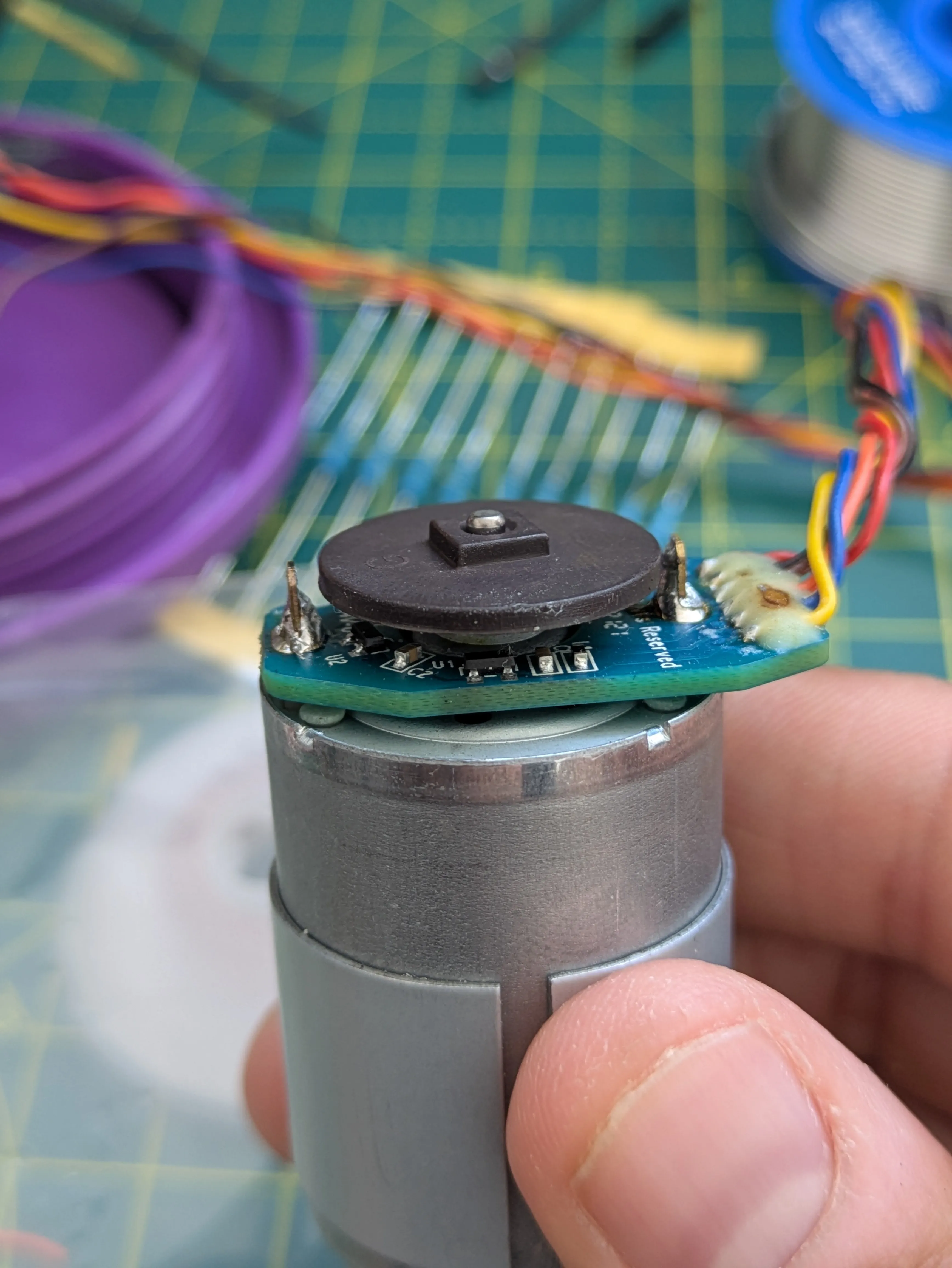
Different track this time. Instead of porting firmware onto the robot, I wanted a tool on my Mac that could talk to it — send a drive command down the serial cable and print back whatever the robot said. The real question underneath was simple: is the wheel’s hall sensor actually alive? I’ve been staring at that encoder board wondering if it’s reporting anything at all. So: cargo run -- F 180, watch what comes back. A probe. And since I’m doing all of this the hard way on purpose, I typed every line myself.
The send path taught me three things in a row, all of them small, all of them the kind of thing you’d .clone() your way past and never learn.
First: I wanted to translate my command letter. My tool takes F or B on the command line, but the firmware’s word for reverse is R (to it, B means brake). Easy — a match:
let fw = match direction {
    "F" => "F",
    "B" => "R",
    _ => "F",
};
The compiler stopped me: expected &String, found &str. And this is the bit that finally clicked. direction came from the command-line args, so it’s a &String — an owned, heap-backed string I’m holding a reference to. But "F" and "R" are &str, string slices, baked into the binary. When I call a normal function, Rust quietly converts one to the other for me; a match won’t. So I added .as_str() — match direction.as_str() — and the patterns lined up. I’ve written &str versus String a hundred times without ever feeling the seam. This time I felt it.
Second: I matched on the result of opening the port to get the port out, and then, a few lines later, tried to print the opened value again — and got told it was moved. The match had consumed it. In C++ that value would still be sitting there, half-alive; in Rust it’s just gone, and the compiler knows exactly where it went. Fine. Deleted the line. Moving on.
Third: sending. port.write_all(...) — “cannot borrow port as mutable.” I hadn’t declared it let mut. My reflex was but I’m not changing anything — and then the penny dropped. I’m not reassigning port, no, but writing to the port changes the port: it shoves bytes into the OS buffer, advances internal state. A method that mutates the thing it’s called on takes &mut self, and you can’t call that on a binding you swore was immutable. let mut port, done.
Then the reading half: a fixed 256-byte buffer, a loop, port.read(&mut buf) filling it and handing back how many bytes it got, String::from_utf8_lossy to turn those raw bytes into text. And it worked — the robot answered:
[motor] fwd duty=180The full round trip. My laptop said a thing, the robot did it and reported back, my loop caught the reply. But no encoder numbers. Turns out this firmware only reports the encoder when you ask — an E command — it doesn’t just stream it. So I sent an E on every pass of the loop, and there were the counts:
[enc] A=62 B=0 pos=0 (levels: A=1 B=1)
[enc] A=62 B=0 pos=0 (levels: A=1 B=1)
Here’s where I have to be honest, because this is a learning log and not a highlight reel: the plumbing is perfect and the answer is murky. Channel A sat frozen at 62 the whole time and never ticked up; channel B was flat zero. So my tool works beautifully and the data it fetched says the sensor might not be. That’s a hardware puzzle for another night — but at least now I have an instrument to poke it with.
And then the bit that actually rattled me. I changed my fixed loop to loop {} so it’d run forever, hit Ctrl-C when I’d seen enough — and the wheel kept spinning. Ctrl-C killed my program. The robot never heard a thing. It was still happily executing the last order I gave it, a dead process’s final word, no one left to say stop. I had to open another shell and shove an S straight at the serial device to make it quit.
That’s the thread I’m pulling next. Ctrl-C shouldn’t just execute me — it should let me get a last word out, an S, then exit. In Rust that’s a signal handler flipping a shared flag the loop watches, which drags in a couple of ideas I’ve dodged forever: sharing one value between the handler and the loop, and doing it safely. The wheel that wouldn’t stop is about to teach me ownership across threads.