Blog / Neato D10 Brain Transplant / Ep. 9
episode 9
Buying it was supposed to be the easy part
Last episode ended with a clean list and a promise: the teardown’s finished, the next box is the ESP32, all that’s left is to hit buy. Five motors, four drivers, one buck converter. I even had the part names — 2× DRV8871, 1× Cytron MD10C, 1× logic-level MOSFET, a buck. How hard is a shopping trip?
Turns out a bill of materials and a shopping cart are different documents. The BOM says what. The cart makes you say exactly which one, and that’s where the lookalikes live.
The first “Cytron” wasn’t a Cytron. I found a listing called a “Light & Motor Driver,” 10 A, looked plausible, nearly dropped it in the basket. Then I read the spec properly: it’s driven over UART and MODBUS, controlled by a potentiometer or a USB host, and it’s a single MOSFET — unidirectional. That’s three problems in one. My whole plan is an ESP32 toggling a PWM and a direction pin in real time; bolting a serial-protocol board onto that is a translator I don’t need. And unidirectional kills the one trick I was most pleased with — reversing the roller to cough out a hairball. It was a motor driver wearing another motor driver’s name. The real one — Pihut’s “13A 6V-30V DC Motor Driver,” which is actually a MD13S, the MD10C’s newer sibling — is bidirectional, takes a plain 3.3 V logic pin, and does 20 kHz PWM. That’s the one. The lookalike went back on the shelf.
The side-brush MOSFET had the opposite trap. Last episode I warned myself off the IRF520 because a 3.3 V pin can’t switch it. The board I settled on — a Gravity MOSFET module — passes that test: it triggers cleanly from 3.3 V. But reading the fine print, its switching tops out at 1 kHz. Fine for a brush I only ever turn on or off; useless if I’d wanted quiet high-frequency speed control. For the side sweeper, on/off is all I need, so it stays. One note to my future self scrawled in the margin: it’s a bare switch, so the little brush motor needs a flyback diode across it or the coil’s collapse will bite the FET. I’ve got a drawer of them from the Elegoo kit.
And the buck converter tried to lie to me with a number. I found a tidy little module with a display, “20 W,” “5 A.” Read closer: 5 A is the peak, the “absolute maximum, not for continuous use.” The number it’s shy about is the continuous one — around 2 to 3 A. My Pi 4 alone can pull 3 A under a mapping load, before I’ve added two ESP32s and a spinning LiDAR. A supply living permanently at its ceiling is exactly how you get a Pi that reboots at random and corrupts its own SD card — the kind of ghost that eats a weekend. The honest word to shop for turns out to be continuous, not peak. The one part on the whole list that’s genuinely 5 A continuous is a Pololu regulator, and it’s £38 — more than the two wheel drivers put together. That one I’ll source elsewhere; a proper 5 A RC UBEC does the same job for a fifth of the price, as long as it says continuous and means it.
So the order went in — everything but the buck and a little speaker amp I’ll pick up separately. DRV8871 ×2, the real Cytron, the Gravity MOSFET. The boring parts were boring; the traps were all in the parts that had a plausible twin.
Then I turned the robot over, and the next project looked back at me.
I’ve been so deep in motors I’d filed “sensors” under later. But there they were, and I started pulling them and reading part numbers. A little board stamped BUMP SWITCH 290-0056 — a plain mechanical click-switch, and there are four of them across the front bumper. A lever microswitch, DT-08, tucked in a wheel arch: that’s the dead-man’s switch that knows when a wheel has dropped into thin air, i.e. someone’s picked the robot up. Both of those are the easy kind — a contact closes, an ESP32 pin reads high or low, done. No driver, no analog, barely any thought.
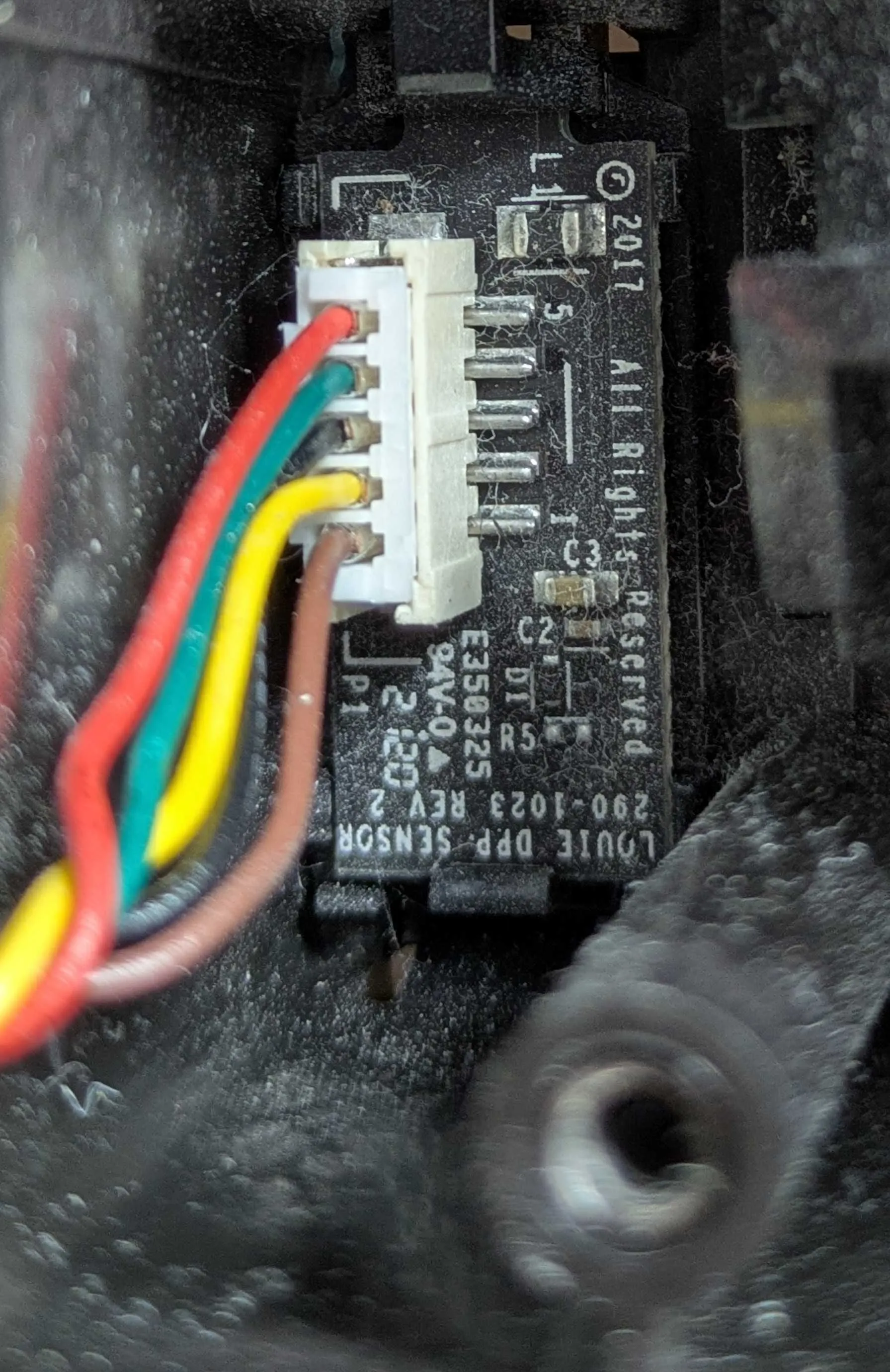
The one that matters is underneath: a small board reading LOUIE DPP SENSOR 290-1023 REV 2, an infrared eye that stares at the floor. That’s a cliff sensor — the thing that stops the robot cheerfully driving off the top step. It doesn’t give a clean high/low; it gives a reflectance reading that I’ll have to feed an analog pin and threshold in software. I haven’t pulled the whole undercarriage yet, so I don’t know how many there are or whether they run at 3.3 or 5 V — both go on the meter next time. This is the sensor I least want to get wrong. Everything else being buggy means a robot that bumps things. This one being buggy means a robot at the bottom of the stairs.
Oh — and there’s a speaker at the back. It has no business being interesting and I want to wire it up anyway. A tiny class-D amp, an ESP32 pin, and the thing can announce when it’s stuck or docked or full. That’s pure dessert, and it’s going on the list.
The good news buried in all this: the sensors add zero new drivers. Switches are free, cliff eyes just need an analog pin. The order I placed today still covers the muscle; the sensors are all signal.
Next box is still the ESP32. But now there’s a second thread waiting for a meter — how many cliff eyes, and what voltage do they want — before I trust this thing anywhere near a staircase.