Blog / Neato D10 Brain Transplant / Ep. 4
episode 4
The motors won't tell you their limits
To spin a motor from a microcontroller you need a motor driver — an H-bridge or a MOSFET — because an ESP32 GPIO pin puts out milliamps at 3.3 V. That’s enough to signal a decision, nowhere near enough to spin a motor. The driver is the muscle: it switches the fat battery current on and off under the ESP32’s command. (There’s no separate “driver for the ESP32” — the ESP32 just runs. The drivers are for the motors.)
So I need drivers. Which drivers depends on current. And here’s the rule that governs the whole purchase: you size a motor driver to stall current, not running current. A motor pulls far more when it’s jammed — brush wrapped in hair, wheel against a wall — than when it’s happily spinning. Size for the happy case and the first time the robot gets stuck, the driver dies.
I have four motors. Good news up front: only three need drivers.
The blower solved itself. It’s that EVERFLOW F121225BU with DC14.4V 2.0AMP printed right on the label — so no measurement needed, the current’s given. But the better news is in the part number. The …BU suffix is Everflow’s four-wire PWM family: it’s brushless with an integrated driver already inside it. I feed it 14.4 V and a PWM signal straight off an ESP32 GPIO (around 25 kHz), and I even get a tach line back to read its RPM — which means I can detect a clog by watching the fan bog down. No H-bridge. In fact you must not put an H-bridge on it — trying to reverse a brushless fan just confuses its internal controller — and you must not measure its winding resistance either, because you’d be probing driver electronics, not a coil. It’s the one motor that needs nothing from me. Smug little thing.
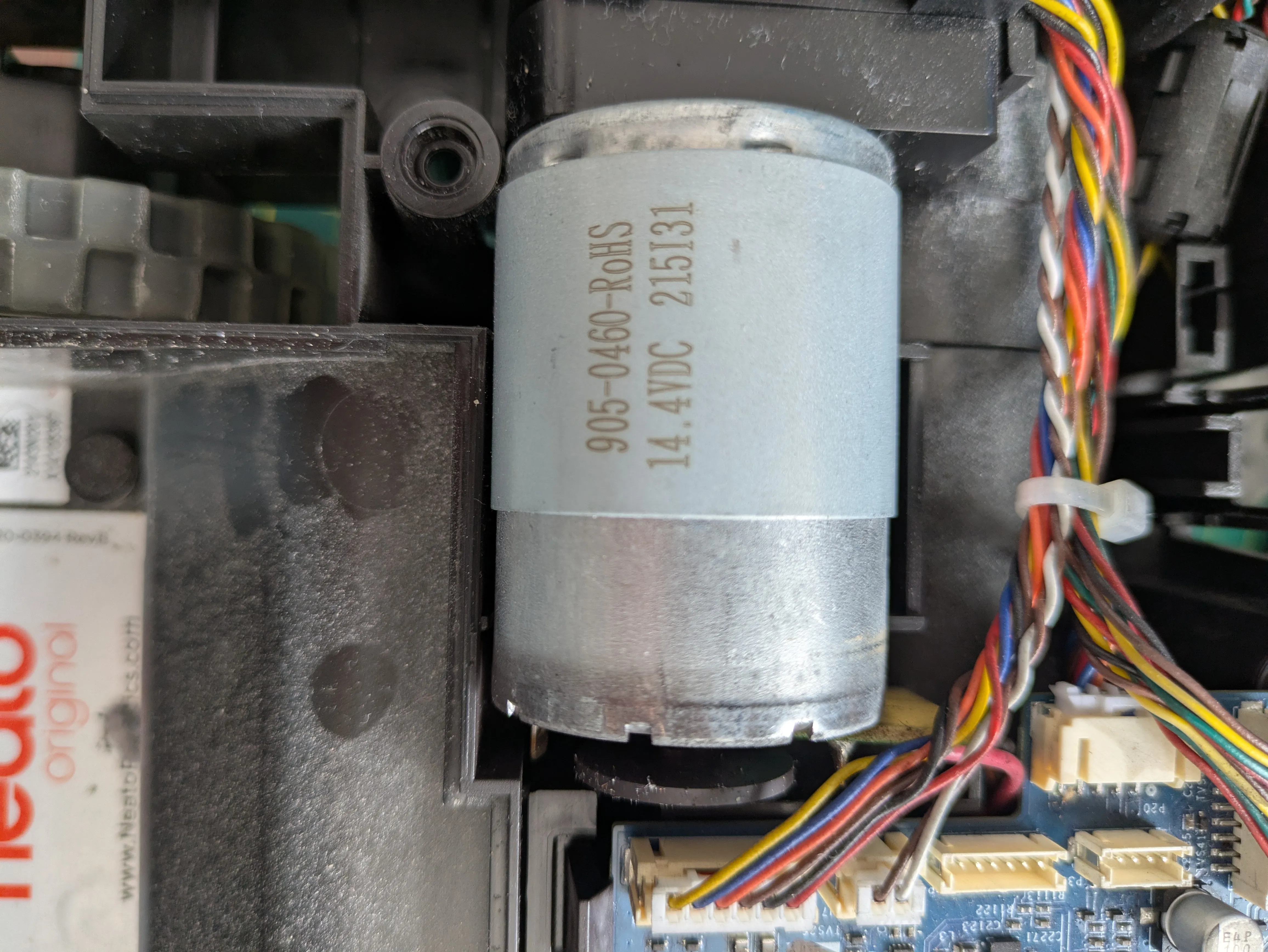
That leaves two drive wheels and the roller brush to size. And this is where my multimeter let me down.
The plan was going to be: power each motor, jam it, read the current spike. Except my meter is an MS8233A — 2000 counts, and critically its 10 A jack is unfused and rated for at most 30 seconds every 15 minutes. A stall inrush is a millisecond spike. A 2000-count handheld can’t catch it, and I’m not keen on shoving a stall current through an unfused jack to try. That’s how you let the smoke out — of the meter, maybe of me.
So I changed method. Instead of measuring stall current directly, I’ll measure winding resistance with no power applied and calculate the stall from Ohm’s law: stall ≈ 14.4 V ÷ R. Safer — nothing’s live — and honestly more trustworthy than a live stall reading this meter could never catch cleanly. The technique needs care (short the probes first to subtract lead resistance; rotate the shaft and take several readings because the commutator position swings the number; keep the lowest), but it’s a bench job I can do right now with what’s in my hand.
The provisional driver shortlist, pending those numbers:
- Two wheel motors → one TB6612FNG, a dual H-bridge that’s happy with 3.3 V logic and good for a bit over an amp per channel. If the measured stall comes in at 3 A or more, I step up to a pair of DRV8871s instead.
- Roller brush → one BTS7960 or a MOSFET module. It only spins one direction, so it doesn’t need a full H-bridge.
- Blower → nothing, as established.
And I’m deliberately not buying any of them until I’ve measured. Buying now is guessing, and guessing at stall current is how you buy drivers that melt.
There’s a nice bonus hiding in my parts bin, too. My Elegoo starter kit has an L293D — far too weak to be a final driver, but perfect as a bench rig to spin a wheel motor gently and sanity-check things. And it has a couple of PN2222 transistors and flyback diodes, which happen to be exactly the classic circuit for driving the LiDAR’s spin motor. So when the LiDAR bring-up comes, I’ve already got the parts to make it turn.
Next actions from here are refreshingly concrete: get the meter in resistance mode and measure three windings; count the wires in the wheel harness (six means a direction-aware quadrature encoder, which I want; five means direction-blind, which complicates odometry); and confirm the blower really does have four wires and not two. Then the parts I’ve ordered arrive, and this stops being a teardown and starts being a build.